


BY NKECHI NAECHE-ESEZOBOR—(BANGKOK, THAILAND)—The International Monetary Fund (IMF) has upgraded its growth projection for Nigeria, citing improved oil prices that have boosted foreign exchange receipts, reserves and liquidity in the economy.
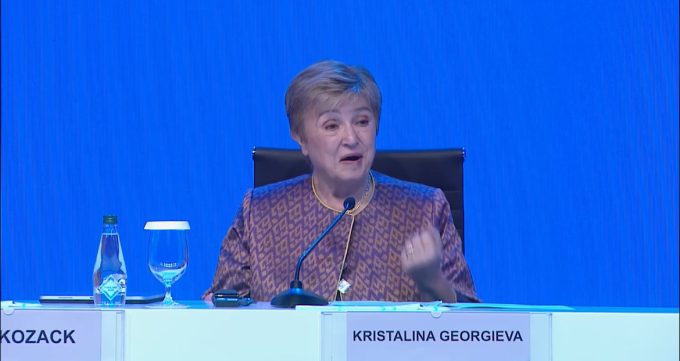
Speaking at a press conference on the Economic Outlook for Sub-Saharan Africa at the 2026 Annual Meetings of the World Bank and IMF in Bangkok, Deputy Director of the IMF’s African Department, Montfort Mlachila, said Nigeria’s growth this year is now projected at 4.2 percent, up from 4.0 percent last year.
He added that growth is expected to be at a similar level of 4.3 percent next year.
Responding to a question from Nigerian journalists on the country’s projections, Mlachila said Nigeria is benefiting from improved oil prices, which have increased foreign exchange receipts, strengthened reserves and added liquidity to the economy.
He said this year’s growth is largely driven by services, in addition to what he described as a very propitious external environment.
Mlachila also pointed to a significant decline in inflation, which began in 2025 and, according to him, has improved the overall macroeconomic situation and the availability of foreign exchange.
Director of the IMF’s African Department, Zeine Zeidane, also the government should prioritize policies to accelerate job creation, attract long-term investment and make growth more inclusive.
He urged Nigeria should to mobilize more domestic revenue outside the oil sector to create fiscal space for education, health and infrastructure.
At the same time, he said, the country should continue structural reforms to become more attractive to the private sector.
Zeidane described Nigeria as a country with a lot of dynamism, many young entrepreneurs and a young, tech-savvy population.
He noted that it is a large market that is very attractive for private investment.
He stressed, however, that structural reforms in governance, the business environment and integration are important, and said these would help accelerate growth and create jobs.
The IMF also projected growth in Sub-Saharan Africa at 4.5 percent in 2026 and 2027, up 0.2 percentage point from its April forecast, giving what it called reason for cautious optimism.
According to Zeidane the region resilience reflects earlier reforms and rapid adaptation, citing subsidy and exchange rate reforms in Ethiopia and Nigeria and structural reforms in South Africa.
It cautioned, however, that “resilience is not immunity,” noting that the regional aggregate masks very different country experiences.
High oil, copper and gold prices are benefiting some exporters, while growth is slowing in non-resource-intensive economies and their external deficits are widening.
Households are also facing renewed cost-of-living pressures, with median inflation projected to rise from 3.4 percent in 2025 to 4.3 percent this year and 5 percent next year.
Governments have little room to respond. Fiscal adjustment before the shock helped lower deficit and debt ratios, but buffers remain thin, with interest payments absorbing around 13 percent of government revenue in a typical country. Borrowing remains expensive, and bilateral aid to the region is projected to fall by a further 12 percent after a steep decline last year.
The IMF said risks remain firmly tilted to the downside, citing possible renewed disruption to energy supplies and a sharp increase in global risk aversion. Conflict and insecurity remain an additional drag in parts of the region, though the region’s ability to adapt and move forward remains.
On policy, the IMF’s first priority is protecting vulnerable households while preserving fiscal space. It said broad fuel price relief is expensive and poorly targeted: in an illustrative scenario in the report, generalized fuel price smoothing could cost about 4 percent of GDP, while transfers to the poorest 40 percent would deliver the same benefit at a cost of at most half a percentage point. Any temporary relief should be transparently funded, capped and time-bound.
Second, it urged safeguarding economic stability. Commodity exporters should save most of their windfalls, including by repaying costly debt, while countries with high import bills should stay the course on fiscal adjustment. For many countries, monetary tightening may be needed to prevent temporary price pressures from becoming persistent inflation, and exchange rate flexibility can help absorb the shock where regimes permit.
Third, policymakers should not lose sight of growth. Reliable electricity, better digital connectivity, stronger skills and a more predictable business environment can unlock private investment and jobs, while regional trade and power integration can expand markets. The IMF said resilience today must not be financed by sacrificing tomorrow’s growth, and that it will continue to support countries through financial support, policy advice and capacity development.