



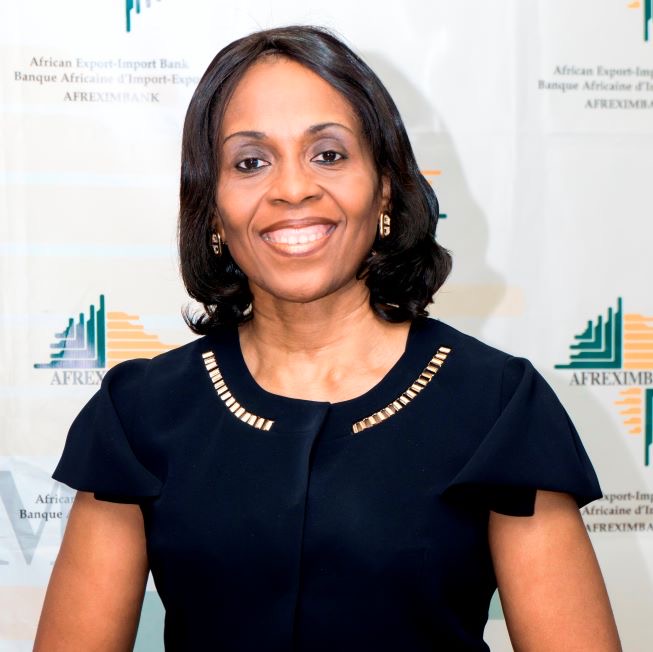
BY NKECHI NAECHE-ESEZOBOR—The Executive Vice President of Intra-African Trade and Export Development at Afreximbank, Kanayo Awani, has warned that closing the continent’s massive annual infrastructure financing gap requires a robust financial architecture anchored by insured capital.
She disclosed this while delivering the keynote paper at the 52nd annual conference of the African Insurance Association (AIO),ongoing in Cairo, Egypt, that Africa currently attracts roughly $80 billion in actual annual infrastructure spending against estimated needs of almost $170 billion. “This leaves a financing deficit of nearly $90 billion, which costs the continent up to 2% of foregone GDP growth per year. To reverse this trend, Awani argued that project funding must be protected by robust risk-transfer mechanisms to unlock institutional investment.
“The gap will not be closed by capital alone,” Awani said. “It will be closed by capital that can be insured, capital that can be syndicated and held with confidence.”
Across most of Africa, insurance penetration remains stubbornly low at just 2% to 3%, compared to a global average of 6.8%. In 2024, only South Africa (11.5%) and Namibia (7%) exceeded the global benchmark. Furthermore, Africa’s entire continental reinsurance market wrote just over $6 billion in premiums—barely 1.6% of the global total.
Awani stressed that these low metrics directly harm continental development, causing projects to be delayed, financing to be priced higher, and too much African risk to be ceded abroad. She noted that while the African Continental Free Trade Area (AfCFTA) has established a massive economic framework of 1.5 billion people with a combined $3.4 trillion GDP, its ultimate goals of industrialization and expanded value chains cannot be realized without local risk absorption.
Globally, insurers hold approximately $42 trillion in assets. Awani proposed that channeling even half a percentage point of that capital toward African infrastructure would begin to fundamentally close the continental financing gap.
The strategy is already gaining traction among development finance institutions (DFIs). DFI participation in African private infrastructure projects shifted significantly from 2022 to 2023, with insurers and export credit agencies increasingly becoming the syndication partners of choice to secure bankability through political risk, credit, construction, and operational interruption insurance.
The conference also spotlighted successful domestic overhauls, with Egyptian Minister of Investment and Trade Mahmoud Farid highlighting Egypt’s recent insurance sector reforms. Farid detailed how a previously controversial Financial Regulatory Authority (FRA) mandate forcing insurance companies and private pension funds to invest a minimum percentage into listed equities has ultimately stabilized the local market and catalyzed four to five upcoming private sector IPOs.
Supporting the drive for wider safety nets, Egypt’s Deputy Minister of Foreign Affairs for African Affairs, H.E. Mohammed Abu Bakr, stated that the reinsurance and insurance sectors are vital to ensuring no individual has to carry the burdens of economic risk alone.
Concluding her address, Awani urged African policymakers to stop viewing insurance as a peripheral service and instead integrate it into the core infrastructure of trade and project finance, noting a direct statistical link between high insurance penetration and manufacturing value-added per capita.