


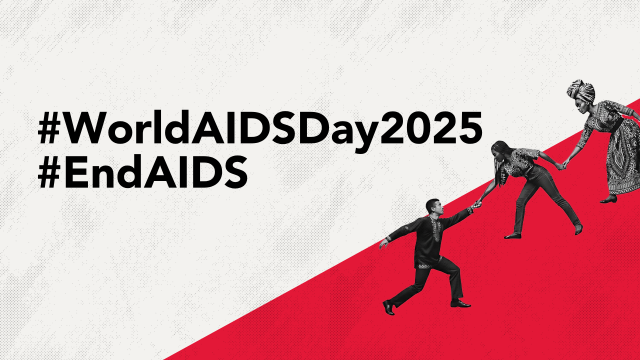
BY PATIENCE OLAJIDE—Today, in the World Health Organization (WHO) is joining partners and communities around the globe to commemorate World AIDS Day 2025 under the theme “Overcoming disruption, transforming the AIDS response”.
There are an estimated 40.8 million people living with HIV (PLHIV) around the world, 610 000 of whom live in the Eastern Mediterranean Region where the number of annually estimated new infections has almost doubled in less than a decade, rising from 37 000 in 2016 to 72 000 in 2024. Yet, fewer than 4 in 10 know their status, and less than a third are receiving treatment, in the Region.
The HIV response is entering a critical moment. Funding dedicated towards HIV is declining which threatens to unravel decades of progress. HIV services are being disrupted, especially in fragile and conflict situations, and community-led services, vital to reaching marginalized populations, are being deprioritized.
Given a wide range of treatment options, HIV has become a chronic treatable infection, if appropriately managed, but increased domestic funding and strengthened HIV services are urgently needed to reach the goal of ending AIDS by 2030.
HIV programmes continue to rely heavily on shrinking external funds. Domestic investments remain woefully inadequate. Meanwhile, stigma, discrimination, punitive laws and the lack of community-based services continue to represent major obstacles to prevention, testing and care.
Without urgent action, the number of new HIV infections and deaths will rise, health systems will face greater strain and the goal of ending AIDS by 2030 will be missed.
It is only through scaling up the response – by sustaining and increasing investment, reigniting commitment, embracing innovation, fully integrating HIV services into health programmes and tackling stigma and structural barriers to treatment – that countries will be able to accelerate and sustain progress towards ending AIDS as a public health threat.
This year, WHO is calling on governments to keep HIV high on national health agendas and increase national investments. It is urging greater integration of HIV services into wider health systems to deliver comprehensive, people-centred care, the scale up of innovative service delivery models, the expansion of prevention, harm reduction and community engagement programmes, and enhanced surveillance, monitoring and targeted HIV responses.
“Today, I call on all governments to raise public awareness, increase domestic funding, integrate HIV into broader health services, adopt innovative approaches and strengthen prevention through digital health and AI,” said WHO Regional Director for the Eastern Mediterranean Dr Hanan Balkhy. “WHO will stand with our countries and communities to build a stronger, fairer AIDS response for everyone, everywhere in our Region.”